Sunday, November 28, 2010

Machine Art: Response to Katie Sparagna's Question

Katie proposed the question, in response to my question about "consumption art", If people consider blindly following orders and using no personal touch or creation art then what is stopping the public from including machine made art?


I continue to use examples from MASS MoCA in my blogs because they are close to us and relate to much of what we are discussing in this course. We need not look further than down the street to MoCA for the answer to this question. I believe MoCA's latest exhibit was mentioned briefly in class, but Federico Diaz's piece entitled Geometric Death Frequency - 141 fits right along with the question. 


Although not done entirely with machines, Death Frequency - 141 was constructed and planned out by machines. Diaz merely took a picture of the courtyard in front of MoCA's main entrance and then transformed the photo into pure data through the use of a computer. The computer then took this data, modulated it and created a three-dimensional structure. This process of manufacturing does not use human hands at all, instead robots who interpret the data piece the "data" together in the way that the picture algorithmically shifted at the 141st frame of manipulation.


Diaz even plans to have one of the robots in MASS MoCA in the coming months to create more pieces which will then be added to the existing piece. This will allow the viewers of the art to participate to an extent in the further process of the piece, showing that people do indeed accept art that is made by machines and that they are interested in the potential theories that can create art. 


My question would be: Would we then consider computer programs that "generate art" (take fractal generators for example) tools for creating art?

Sunday, November 21, 2010

Subway's "Sandwich Artists"

I know that Subway is probably the last thing one would think about when contemplating the nature of art, but I was enjoying one of their cheap and quick meals the other day and noticed something that caught my eye.


On the bottom of the cup that contained my soft drink, there was a trademark I had never noticed before. The trademark was for what they call "Sandwich Artist". This caught me as odd because I had never considered the people who stand behind the sneeze guard, tending to the prepackaged compartments of vegetables and meat products as artists.

How I would describe the job of making Subway Subs is not that of an artist. Your supplies are picked out for you and standard at every store. The sandwiches are standardized and leave very little room for experimentation other than the variation of orders from various customers.

My question is: Can we consider those make food in the fast food industry "artists" as the companies would like us to believe?

Sunday, November 14, 2010

Warhol

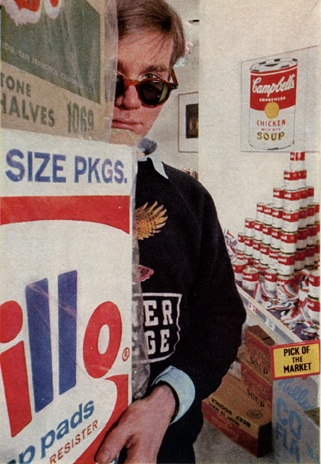
In Danto's article "The Artworld", he mentions the work of Andy Warhol on a few occasions while discussing his own theory of art. Danto uses the example of Warhol's Brillo Pad painting to expound on his idea about art as imitation.


Another famous example of Warhol's artistic imitation of consumer products is the Campbell's Soup can. Warhol made a career for himself capitalizing on social criticisms and exploring the intentions of modern advertising, which is why I find it so interesting that now there is a corporate interest in Warhol.


Warhol's prints of Marilyn Monroe can be seen on everything now from bags to T-Shirts and are sold in popular stores at, in my opinion, hefty prices. I don't believe the intention of Warhol's work was to perpetuate consumerism, but I may be mistaken. Warhol may have been predicting through these pieces the way that the world works or will work in respect to art. He predicted that everyone will experience their 15 minutes of fame, and through advancements in the internet, this is becoming a far more common occurrence.


My question then would be:
Has Warhol's artistic message been diluted in current years or are things molding after the way he was predicting?

Response to Katie Sparanga's Post.

In Katie's blog, she brings up the questions:   
1.  If an artist creates a piece of art and then it is changed, what does the work                  become?
2.  Can a person create art with no formal background?


Katie uses an example of an elementary school teacher who alters her pupils art pieces to make them better. 


Since this is a non-formal forum of expression, I will also use an anecdote to help enunciate my feelings on the subject. I have a friend who is much younger than we are, but a great artist. She has very little background in the field of art and is mostly self-taught, but is very good at what she does. She has an apprenticeship at an art gallery which generally entails her recreating pieces of work of the gallery's main artist.


The pieces which she recreates are then sold in the gallery for thousands of dollars. Their relationship has come to the point where the main artists sketches an idea of a drawing and tells the girl to draw the form in different positions. These pieces are then sold for even more than the others.


In my opinion, and with talking to the girl it is her opinion as well that these pieces which she is creating based off the rough idea of her mentor are brand new pieces. Simply because the idea is someone else's and you make a modification to it, it is still an individual piece. This would be different if we were discussing conceptual art like Sol LeWitt, but here we are discussing art which puts a high emphasis on the individuality of a piece which makes the price so expensive. 


I believe that a person can create art with no formal background, but we might want to get more specific with this question before understanding its full implications. I also believe that if an art piece is changed that it becomes a new piece unless there was an initial conscious decision for collaboration. Neither example we have used shows any conscious effort to collaborate.


Q: Can the art of an individual with no formal background be considered legitimate by the art community?


Saturday, November 6, 2010

Response to Katie's Question on Hume

Katie posed the question: What have humans done with art in a viewing sense that makes us so much more superior to animals?


In Katie's blog entry about Hume, she mentions that "animals instinctively know how to do everything we had to learn" which I feel may lead to the answer of her question. If we are to imagine humans during a time before the development of what we call "consciousness", we operated in similar ways to that of other animals. We would have acted solely on instinct within the intention to survive. 


Through our growth as conscious beings, we strive for efficiency in the menial tasks that we used to live and die for, utilizing our new found ability to think beyond the nest and create machines to do those tasks for us. I am not saying, however, that this collective growth makes our art now any more superior than the bowls and vases of the past. What I am saying is that our direction has shifted because of a change in perspective. We are now not only able to create and look at art, but we are able to infuse our own ideas into its meaning. 


It is true, though, that because of this growth of consciousness, we tend to not look at the smaller beauties in life or at least appreciate them to their fullest, which may be a reason why we attempt to create art. It does seem that we often over analyze art and all things for that matter because without a purpose of supplying food for our young or constructing a structure of protection, we have delved more into the mental space and live primarily in it. This distances us from our environments, which is why we don't appreciate the little things and it may cause us to over think the minor details in the rapidly evolving and semi-schizophrenic world of art. 


We have, as modern humans, made a split into abstraction and the only ones who will be calling us superior beings are others of our kind. 


Q: Could we ever define the strive for efficiency in our technological devices art?

Wednesday, November 3, 2010

Sol LeWitt


As we were discussing Weitz in class, I couldn't help but think of Sol LeWitt's Wall Drawing Retrospective at North Adams' very own MASS MoCA. LeWitt is sometimes referred to as the grandfather of Conceptual Art.

In his work the concept for the art is described in a series of directions written down. LeWitt was looking to take the importance of the physical piece out of the equation and draw from the meaning of solely unique pieces of art. Think of how much importance is put on an individual Picasso or Pollock piece only because it is the only one. LeWitt's conceptual wall drawings, however, are all individual and can be recreated at any time in almost any place, with these factors contributing to the individuality of the wall drawings.


LeWitt's work is perfect for MASS MoCA because all art that goes into MoCA utilizes the environment. All artists at MoCA take a residence there and create there art based around the building. Sol LeWitt's art in theory can work anywhere because the artist has the ability to add their own touch to the standards which LeWitt set. So the same piece based off of the instructions can be as small as a book cover or as large as the walls seen at MASS MoCA.

I was wondering what Weitz would have to say about LeWitt's work. I feel that he would appreciate LeWitt's understanding that art is defined more by its concepts than on the genre even of the work.

Q: Do you agree that Weitz would show interest in LeWitt's work?

Saturday, October 23, 2010

Deweyan Journalism Revival

I found much of what Dewey had to say in our reading about art intriguing and I began to wonder what other fields he might have either influenced or thought about himself in this way.

Upon doing a little bit of research, I came across a few mentions of Dewey's modern influence on the field of journalism. In Dewey's 1927 release The Public and It's Problems, he tackles issues of his time such as can true Democracy work in the modern world? Although I have yet to read the text, there is also another interesting idea that stems from this book.
In this text, Dewey proposes a clear definition as to what public really means. He puts forth the idea that publics are spontaneously forming groups of individuals who share the indirect effects of a particular action. This definition also affects the way we look at journalism. The idea of public journalism, which depends on the people who are experiencing the moment, is meant to draw away from elitist outsider journalism.

Dewey's public journalism gave many writers a new way to look at things and created a trend in the 80's. The most recent example I can think of to do with this idea of public journalism rather than spectator journalism would be the Iran election, where users uploaded pictures, videos and first-person accounts directly from the streets on Tehran. Through the recent developments in technology, specifically mobile technology, the average citizen now has the potential to capture and deliver news to the globe far faster and less restricted than newspapers ever could. Public journalism allows for people to become more informed about what is truly going on in government and everything else, to create more informed and educated citizens, two essentials to a true democracy.

Q: Do you think that Deweyan Democracy is possibly even with the accessibility of new technological mediums?